
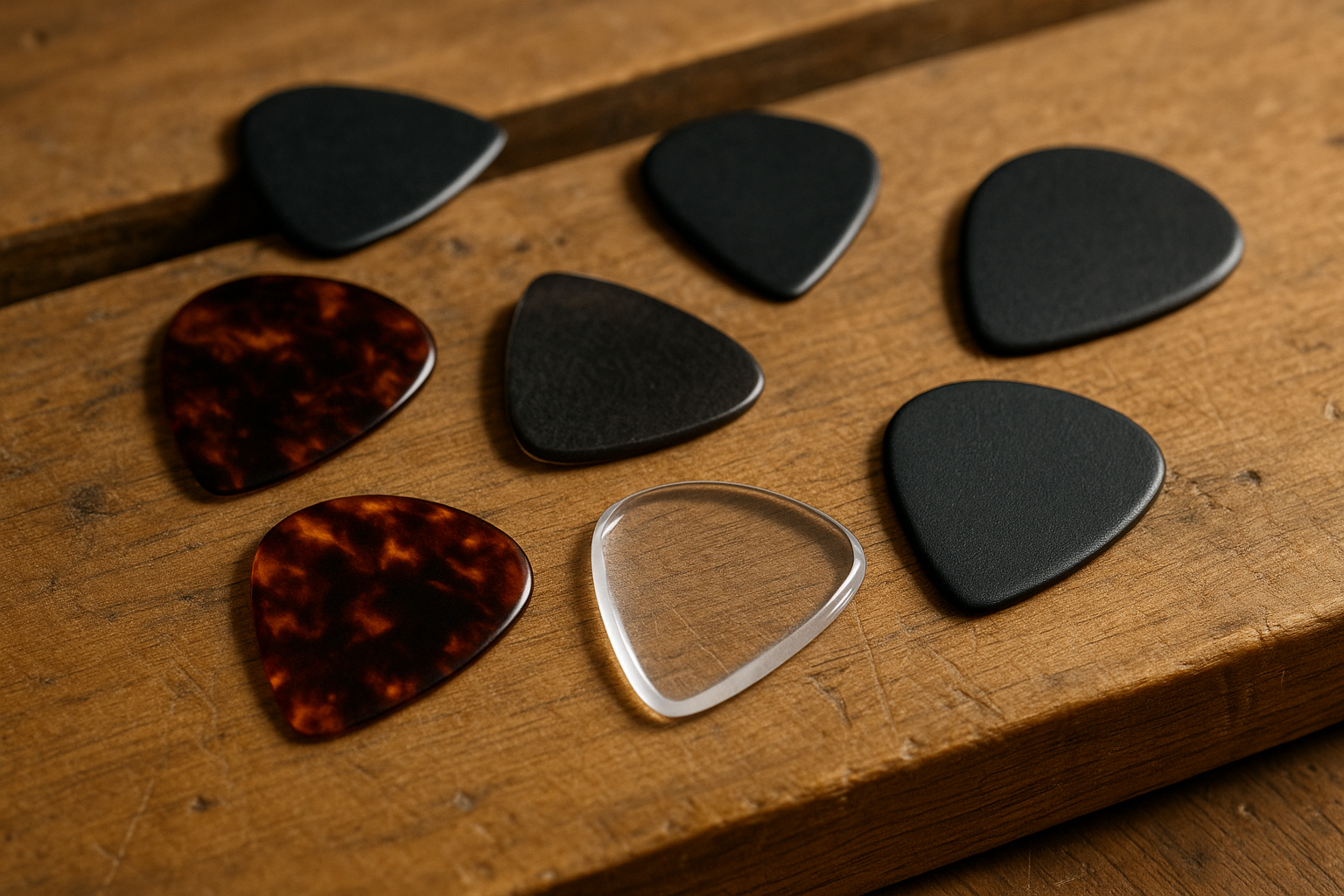
A quick, practical summary to get you started.
Your guitar pick is not just a piece of plastic; it’s a fundamental tone-shaping tool. The perfect pick for you exists at the intersection of three key elements: material, geometry, and technique. Understanding that matrix helps you choose a pick that complements your instrument, playing style, and desired sound.
The Unsung Hero of Tone: Why Your Pick Matters More Than You Think
In the grand orchestra of guitar tone, we obsess over pickups, pedals, and tonewoods. We spend thousands on amplifiers and meticulously select string gauges. Yet, the very first point of contact in that entire chain—the humble guitar pick—is often an afterthought, grabbed from a jar on the counter or chosen for its color. As a luthier who has spent decades chasing the nuances of sound, I can tell you with certainty: **your pick is one of the most powerful, immediate, and cost-effective tools you have for shaping your voice on the guitar.**
Think of it this way: the pick is the transducer that converts your physical intent into vibrational energy in the string. Every aspect of its design influences the character of that initial vibration. A thick, unyielding pick made of a dense material will transfer energy with maximum efficiency, producing a strong, clear fundamental with a sharp attack. A thin, flexible pick will bend on impact, storing and releasing energy more slowly, resulting in a softer attack, a brighter wash of overtones, and a feeling of “snap.”
This article is your playbook. We’re going to build a simple but powerful mental model—a **Tone Matrix**—that connects **Material**, **Geometry**, and **Technique**. By the end, you won’t just be choosing picks; you’ll be *specifying* them. You’ll have the vocabulary and understanding to find a plectrum that feels like an extension of your hand and unlocks the hidden potential in your guitar.
The Three Pillars of the Tone Matrix
To truly understand how a pick performs, we need to break it down into its core components. These are the three axes of our matrix:
1. **Material:** The substance a pick is made from determines its density, stiffness, surface texture, and damping properties. This is the foundation of its sound. Does it glide silently over the string, or does it have a characteristic “chirp”? Is it rigid or compliant? We’ll explore everything from classic celluloid and modern polymers like Ultem to natural materials like bone and wood.
2. **Geometry:** This covers the pick’s physical form—its overall shape (e.g., the classic 351, the pointed Jazz III, the broad Triangle), its thickness (gauge), and, most critically, the profile of its **edge**. A sharp, beveled edge will release the string with surgical precision, ideal for fast, articulate passages. A rounded edge will produce a fatter, warmer, and more forgiving attack.
3. **Technique:** The final variable is you. How you hold the pick (your grip) and the angle at which you attack the string can radically alter the performance of any given pick. A flat, parallel attack maximizes the pick’s surface contact, producing a full-bodied note. Angling the pick (edge picking) reduces contact area, creating a thinner, brighter, and often quieter sound.
By plotting these three factors, we can start to predict how a pick will sound and feel before we even play a note.
Pillar 1: Material - The Foundation of Feel and Sound
Material is the soul of the pick. It dictates the baseline of its tonal character. While we’ll dedicate full articles to each of these categories, let’s establish the key families and their general properties.
* **Classic Polymers (Celluloid, Delrin®/Acetal):** Celluloid, the original plastic, is known for its balanced warmth and a smooth, familiar feel. It wears gracefully but is flammable and can degrade over time. Delrin (often identified by the Fender or D’Andrea brand names) is slicker, with a slightly brighter, glassier attack and excellent durability. It’s a workhorse for a reason. * **Modern Engineering Polymers (Ultem/PEI, PEEK):** These materials are prized for their extreme stiffness and low friction. Ultem (the amber-colored plastic) is often compared to tortoiseshell for its bright, articulate, and clear tone. PEEK is even more rigid and durable, offering a very direct, high-fidelity transfer of energy, making it a favorite for players seeking maximum clarity and speed. * **Natural Materials (Wood, Bone, Horn, Casein):** Organics bring unique character. **Wood** picks tend to have a warm, compressed attack, with different species offering subtle variations. **Bone** and **horn** are dense and bright, producing a sharp, clear transient. **Casein**, a protein-based plastic derived from milk, is a fantastic and ethical alternative to genuine tortoiseshell, offering a similar density, warmth, and smooth glide. * **Exotics (Metal, Stone, Acrylic):** These are the special effects of the pick world. **Metal** picks (steel, brass, copper) offer the brightest, most aggressive attack possible, but can cause premature string wear. **Stone** (like agate) is incredibly dense, producing a pure, bell-like tone. **Acrylic** is a versatile and visually striking material that can be polished to a glass-like smoothness, offering a very clean release with minimal pick noise.
Pillar 2: Geometry - Shaping the Attack and Release
If material is the soul, geometry is the body. It’s how the pick physically interacts with the string.
* **Overall Shape:** The silhouette of the pick determines how it feels in your hand and how much control you have over the tip. A large **Triangle** (like a Fender 346) offers three identical tips and a large gripping surface, making it stable for strumming. The classic **351 “Fender” shape** is a versatile all-rounder. A small, pointed shape like the **Jazz III** offers unparalleled precision and control for intricate lead work, as its small size and sharp tip make it easy to navigate tight string spacing.
* **Thickness (Gauge):** This is perhaps the most commonly discussed attribute, and for good reason. It controls the pick’s flex. * **Thin Picks (under 0.70mm):** These have a lot of give, which creates a bright, snappy, and percussive attack with less low-end. They are excellent for brisk acoustic strumming, as the flex prevents the pick from “choking” the strings. * **Medium Picks (0.70mm - 1.20mm):** A versatile middle ground, offering a balance of flexibility for chords and stiffness for single-note lines. * **Heavy Picks (over 1.20mm):** These have very little to no flex. They transfer energy directly to the string, resulting in a strong fundamental, more volume, and a warmer, fatter tone. They are favored by flatpickers, jazz players, and rock guitarists for their authority and control.
* **The Edge Profile: The Secret Weapon:** This is where the magic happens. The shape of the pick’s edge dictates the speed and character of its release from the string. A standard, mass-produced pick has a simple, squared-off edge. A custom-crafted pick can have a precisely sculpted bevel. * **Rounded Edge:** A soft, bullnose-style edge creates a warm, round, and forgiving attack. It’s the sonic equivalent of a soft focus lens. * **Sharp / Micro-Chamfered Edge:** A crisp, defined edge provides a brighter, more articulate attack. It’s a high-definition sound. * **Speed Bevel (or Asymmetrical Bevel):** This is an edge that is angled, typically to match the player’s picking motion. It allows the pick to glide over the string with less resistance, enabling greater speed and reducing pick noise. This is a hallmark of many boutique and handmade picks.
Pillar 3: Technique - The Human Element
Finally, we come to the most important variable: you. The way you hold and move the pick can either enhance or negate its designed characteristics.
* **Grip:** A firm grip on a heavy pick ensures all your energy is transferred to the string. A looser grip allows the pick to move slightly, which can soften the attack and introduce a bit of “snap.” * **Attack Angle:** * **Parallel Attack:** Hitting the string with the pick held flat against it maximizes contact and produces the fullest, roundest tone the pick can offer. * **Edge Picking:** Angling the pick so that one of the rounded shoulders makes contact first creates a much brighter, thinner, and often “chirpier” sound. This is a key technique for many rock and metal players to get aggressive harmonics and bite.
Building Your Personal Tone Matrix
Now, let’s put it all together. Instead of thinking “I need a new pick,” start thinking like a luthier specifying a tool for a job. Ask yourself:
1. **What is my goal?** (e.g., “I want a warmer tone for my bright acoustic guitar,” or “I need more precision for fast metal riffs.”) 2. **What is my starting point?** (e.g., “I currently use a standard 1.0mm Delrin pick.”) 3. **Which pillar should I change?** * To change the fundamental character of the sound, change the **Material**. (e.g., moving from Delrin to Casein for more warmth). * To change the attack and feel, change the **Geometry**. (e.g., moving to a thicker gauge for more power, or adding a speed bevel for smoother playing). * To get more variation from your existing picks, change your **Technique**. (e.g., experiment with edge picking to brighten your sound).
Here’s a simple example. A bluegrass flatpicker needs volume, clarity, and speed on an acoustic dreadnought. Their matrix might look like this:
* **Material:** Casein or Ultem (for stiffness and clear tone). * **Geometry:** Large Triangle shape (for a secure grip), heavy gauge (1.4mm+), with a rounded tip and slight speed bevel (for a warm-yet-fast release). * **Technique:** A firm grip with a mostly parallel attack to drive the top of the guitar.
Contrast that with a funk rhythm player:
* **Material:** Nylon or a medium-gauge polymer (for flexibility and snap). * **Geometry:** Classic 351 shape, medium gauge (0.88mm), with a standard edge. * **Technique:** A relaxed grip, allowing the pick’s flex to do the work, creating that classic “clack” on the muted strings.
Your First Experiment
Don’t just take my word for it. Try this simple experiment. Take your current favorite pick and play a simple, repeating musical phrase. Listen closely to the attack, the sustain, and the noise of the pick against the string. Now, simply angle the pick 45 degrees and play the same phrase using the edge. The difference is often staggering. You just fundamentally changed your tone without spending a dime.
This is the power of the matrix. It’s a framework for intentional, predictable change. In the articles to come, we will dive deep into each of these pillars, exploring every material, every shape, and every edge profile in detail. But for now, start listening. Your pick is talking. It’s time to learn its language.
---